Not Just Another Assault

By Brad Gallagher:

New York City has always been known to be a high crime city. From the 1960’s through the 1980’s the New York City crime rate increased consistently year after year through 1990, which would be recorded as the year New York City saw the greatest number of crimes ever. A few years later, Rudy Giuliani was elected Mayor of New York City, and his “Tough On Crime” policies proved successful in bringing the crime rates back down. But, not before the December 8, 1980 murder of John Lennon, and the October 4, 1986 assault of news anchor Dan Rather. Both of which had a profound influence on the world of rock and roll.

Lennon was one of the greatest singer/song writers in rock history, and even though I was not his biggest fan I appreciated his talent and his work. The world of rock lost an icon that day. But believe it or not, in 1986, with the assault of Dan Rather the world of rock gained a song which would go on to become a major rock hit.

As The Story Goes:

Dan Rather was an iconic news anchor who started his carrier in Texas where he hit the national limelight in 1961 when his reporting saved thousands of lives during hurricane Clara. He was also well known for his reporting of the assassination of John F Kennedy in 1963. During the 1960’s and 1970’s he served as White House correspondent and also as a foreign correspondent in both London and Viet Nam. And, in 1981 he was promoted to news anchor on the CBS Evening News, where he remained for 24 years.

It was during this time at CBS that the assault took place. Rather was living in an apartment in Manhattan during those years, and would frequently walk home along Park Avenue. On one particular evening while he was walking home, a man approached him from behind and punched him in the head. Rather attempted to get away from the man, but another man chased him down and beat him and kicked him repeatedly. Fortunately for Rather, there was a doorman at a building near by who saw what was happening and rushed to his aide. The assailants got away that night, and the assault went unsolved for a number of years.

Fast forward to August of 1994, when an NBC employee was shot and killed by a man who was trying to enter the “Today Show” studio. The man’s name was William Tager. He was quickly caught by the police that day and during the investigation they discovered Tager’s motivation for wanting to enter the studio. It turns out that Tager was under the impression that the television industry was monitoring him, while at the same time beaming messages into his head.

Tager was sentenced and sent to prison, and during the crime investigation it was determined that he was the same man who had assaulted Rather eight years earlier. You see, during the Rather assault, the assailant kept repeating the same question. “Kenneth, What’s the frequency?” “Kenneth, What’s the frequency?” He said that he was just trying to find out what the frequency was that they were using to beam those messages into his head so that he could block it. Apparently Tager thought that Dan Rather knew the frequency, and when he failed to get the frequency from Rather he decided to break into a studio in hopes of finding the frequency there. Tager was sentenced to 15 to 25 years for the murder of the NBC employee, and was released on parole in 2010.

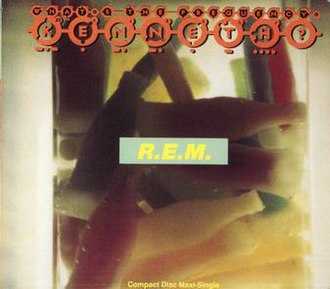
After the story of the attack on Dan Rather got out, the Phrase “Kenneth, What’s the frequency” became a pop-culture reference. And in case you have not yet guessed, that is the story, and phrase, that inspired the 1994 “R.E.M.” hit song, “What’s The Frequency Kenneth”. The song hit #21 on the Billboard Top 100 charts in 1994, and #1 on the Billboard Alternative charts.

And, if you have ever wondered why the tempo slows at the conclusion of the song on the original release on the album “Monster”, it is quite simple. During the recording, bassist Mike Mills started playing slower toward the end of the song and the rest of the group just followed suit. But it wasn’t until lead guitarist, Peter Buck, glanced over at Mills that they realized that he looked a little strange. As it turns out, Mills slowed his tempo because he was suffering from appendicitis. They quickly rushed him to the hospital, but they never went back and rerecorded the take. And that is the take that went on the album.

So now you know. Come back and see me really soon right here on As The Story Goes.

What’s The frequency Kenneth official video: https://www.youtube.com/watch?v=jWkMhCLkVOg
Did you know that you can have my blogs delivered straight to your inbox? Just visit my home page and sign up. https://as-the-story-goes.com/home/
A Good Old Fashioned Bottling

By Brad Gallagher:

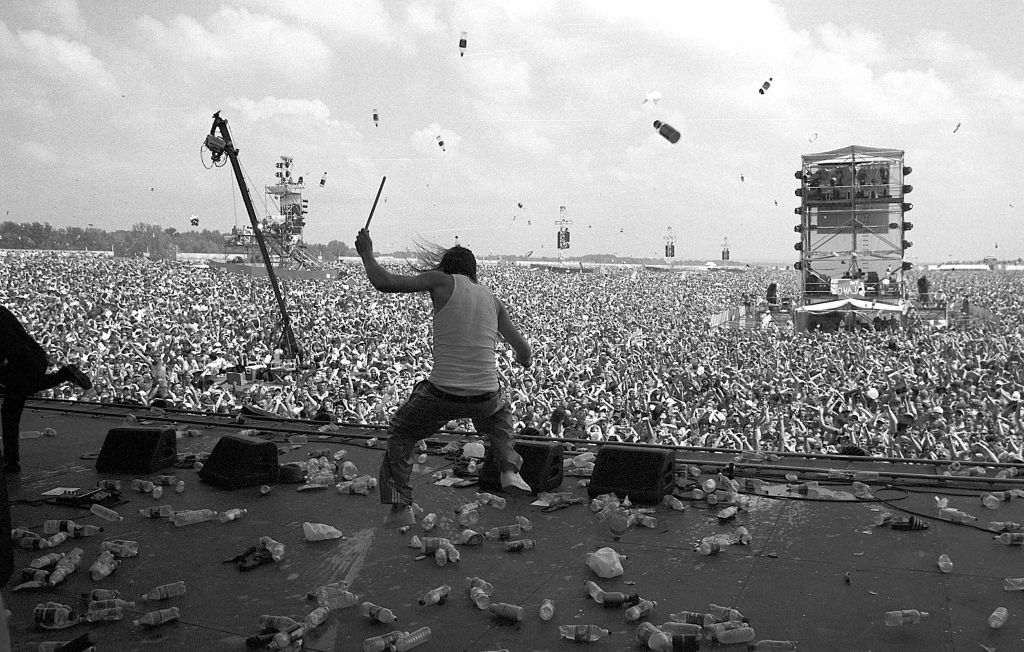
“Bottling”?? What’s a bottling? Well, it was once described this way: “Bottling is an action where a concert audience throws various objects at the performers onstage. This generally happens at festivals when one act in the lineup is of a different genre or audience from the rest of the bands, especially festivals where the majority of bands are related to heavy metal and punk rock music styles.”1

The practice is said to have begun back in the 1970’s. One famous bottling occurred in 1974 when “The Stooges” were performing at The Michigan Palace for an audience comprised mostly of bikers. Apparently the biker audience was not particularly fond of The Stooges’ style of music, and began throwing beer bottles, ice, eggs, and anything else they could get their hands on at led singer “Iggy Pop” as he sang. The Stooges continued to play, however, amidst the barrage of incoming projectiles and a lot of verbal heckling. But eventually Iggy snapped and singled out one of the rather loud hecklers. He ran down into the audience and started a fight with the guy, but, since the guy was bigger, Iggy ended up getting the tar beaten out of him. The concert ended and Iggy wound up back in his hotel room being attended to by a doctor. The concert that night was recorded and published on their live album titled “Metallic K.O.”, and if you listen carefully to it you can even hear the sound of bear bottles hitting guitar strings.

The practice of bottling continued through the 1970’s with acts such as Led Zeppelin, AC/DC, The Ramones, and Jethro Tull all getting bottled on different occasions. And on October 10, 1977, someone in the audience at the beginning of the encore at the Aerosmith concert in Philadelphia, threw a Cherry Bomb up on stage and injured lead singer Steven Tyler and guitarist Joe Perry. I remember this because I had a ticket to the October 11, 1977 Aerosmith concert in Philadelphia that was cancelled due to these injuries. I never had another opportunity to see them in concert again. #notbitter

In the 80’s and 90’s the tradition went on with the bottling of artists such as Bonnie Tyler, The B-52’s, Meatloaf, Joan Jett, The Sex Pistols, and even Pearl Jam. In the 2000’s, The Strokes and The Plain White T’s were both bottled at different concerts, each while opening for Metallica, Iron Maiden had eggs thrown at them, and Guns and Roses were bottled just because they arrived late to their show. Even Lady Gaga, as recently as last July, had something thrown at her while on stage.

But there was one band who, after getting bottled on stage decided to make something of the experience.

As The Story Goes:

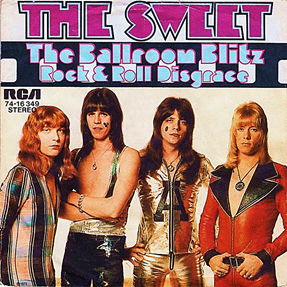
Back on January 27, 1973, a group of young men by the names of Brian Connolly, Steve Priest, Andy Scott, and Mick Tucker were performing at the Grand Hall in Kilmarnock Scotland when they were bottled right off the stage. Priest said that he thought they were bottled because of their edgy appearance which included lipstick and eye shadow. Others thought it was just because the audience was unfamiliar with their style of music. The incident happened a year or so before the Iggy Pop incident, and well before heavy metal and punk rock were even a thing. But it did occur, and the band made a fortune off of the experience.

You see, this particular bottling inspired a hit song that reached #5 on the US Billboard Top 100 Chart in September of 1973, and #2 on the UK Singles chart. I am sure that at some point in time you have heard it. It start out with Mick Tucker slamming the cymbals with his drum sticks and then leading into a drum solo: tuck-a-tuck-a, tuck-a-tuck-a, tuck-a-tuck-a, tuck-a-tuck-a, followed by:

Brian: “Are you ready Steve?”

Steve: “U-huh”

Brian: “Andy?”

Andy: “Yeah”

Brian: “Mick”

Mick: “Okay”

Brian: “All right fellas……let’s goooooooo!”

That’s right, it was “Ballroom Blitz” by a band that was originally known as “The Sweetshop”, but changed their name to “The Sweet” in the early 70’s. Today, we just know them as “Sweet”, a band who learned early on how to turn an uncomfortable experience into a gold mine.

Sweet became one of the biggest British glam rock bands of the 1970’s. They scored 13 top 20 hits during the 70’s on the UK charts, and 4 top 10 hits on the US Billboard charts before Connolly left the group in 1979. Their US hits included “Ballroom Blitz”, “Fox On The Run”, “Little Willy”, and “Love Is Like Oxygen”. Over the years, Sweet has sold over 35 million albums worldwide, and the hit song “Ballroom Blitz” has been streamed more than 144 million times on Spotify alone. As of today, Andy Scott is the only surviving member of the original group, but he is still active with his version of the band “Sweet”.

So now you know a little bit about a bottling. Please don’t try it at home. But DO come back and see me really soon right here on As The Story Goes.

Ballroom Blitz video: https://www.youtube.com/watch?v=r8pYpii2Atg

Did you know that you can have my blogs delivered straight to your inbox? Just visit my home page and sign up. https://as-the-story-goes.com/home/
[1] Jonze, Tim (2007-08-25). “Hitting rock bottom”The Guardian. London. Retrieved 2008-06-19.

Saturate Before Using

By Brad Gallagher:

Today’s post is going to be short and sweet. It is about a little tidbit I recently heard on the radio in regards to Jackson Browne’s debut album that was simply titled “Jackson Browne”. Even though many rock artists start their careers with an album named after themselves, this particular album carried with it a certain amount of confusion as to its name.

As The Story Goes:

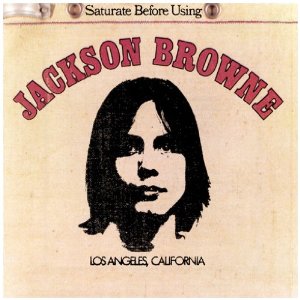
Jackson Browne’s self-titled debut album, featuring his hit songs, “Doctor My Eyes”, and “Rock Me On The Water” peaked on the Billboard 200 charts at # 53. The title of the album, as I mentioned was just “Jackson Browne”, however, many fans referred to it under a different name.

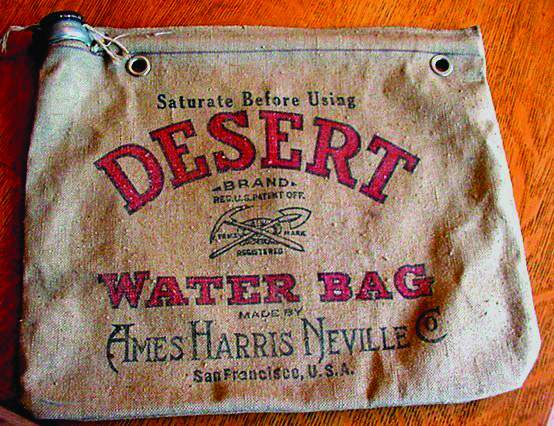
It all came down to the cover art. Browne decided to use a picture of an old time desert water bag, that he had collected in his travels, as the cove art. The bag was designed to be filled with water and then hung over your hood ornament or radiator cap. Then as you drove through the desert the natural evaporation would cool the water and also help keep the radiator cool. The bag bared the phrase “Saturate Before Using”.

He described it like this: “I remember being on the phone with Gary… talking about what the album cover should be, and I happened to be in a room that had a water bag on the wall. It was just one of the things that I collected driving around on trips and stuff. And I was looking at this bag as he was saying ‘what do you think it ought to be?’ I was thinking, ‘well, it could be a water bag.’ … it said ‘saturate before using’ on the front … ‘You know, Gary, on mine, it says this on the back.’ And you said, well, so?’ And ‘if you put it on the front, people are going to think that’s the title.’ And you said, ‘don’t be ridiculous. Who would think that was the title?’ I said, ‘Yeah, you’re right.’ So, not only does everyone think that’s the title of that album, but my record company thinks that’s the title of the album.”1

The record company, Asylum Records, tried to convince him not to use that cover art, but Browne refused to concede. And to this day there are still those who think the title of his first album is “Saturate Before Using”.

From this debut album, the song “Doctor My Eyes” peaked at #8 on the Billboard charts, and “Rock Me On The Water” peaked at #48. Not bad for a debut album from an unknown 21 year old singer/song writer. Who, by the way, has a tremendously crisp and clear singing voice. And great hair. I encourage you to check it out. And come back and see me real soon right hear at As The Story Goes.

Doctor My Eyes Video: https://www.google.com/search?rlz=1C1CHBF_enUS873US873&tbm=vid&q=doctor+my+eyes&sa=X&ved=2ahUKEwj7p7Gosv_7AhUsMTQIHcePDt8Q8ccDegQIIxAD&cshid=1671237024755709&biw=1382&bih=603&dpr=1.25#fpstate=ive&vld=cid:e251bdf6,vid:_cqoI65z-jo

Did you know that you can have my blogs delivered straight to your inbox? Just visit my home page and sign up. https://as-the-story-goes.com/home/
[1] Burden, Gary & Diltz, Henry. Under The Covers DVD, Jackson Browne Audio Interview. Archived May 2, 2012, at the Wayback Machine 2002

Me and Julio

By Brad Gallagher:

Today is Thanksgiving and we are celebrating in Mazatlán Mexico this year. We have been here for a few days and yesterday we had the privilege of meeting a little boy while we were swimming in the pool. He kept swimming up to us and then swimming away quickly when we looked at him, and then swimming up again. It appeared that he wanted to befriend us, but was too shy to be the first to speak. After all, he did not know any English, and we know very little Spanish. We do, however, know just enough to have said “Como Se Llama?” He responded with just one word, “Julio”, and he quickly swam away again. At that point his parents called to him and he left. We never saw him again.

Immediately, however, I started to sing “Me And Julio Down By The School Yard” by Paul Simon quietly in my mind. I even sang it out loud a couple times. And I was reminded of a story I heard a few years back about the song.

As The Story Goes:

Paul Simon grew up in New York City in the borough of Queens. It is said that he had a childhood friend named Julio who he spent a lot of time with while playing in the playgrounds and school yards around his home. There is no documentation to prove that this was a real friend of Simon’s, but I am inclined to believe that it is true.

On one particular day while in a school yard in Corona, a sub neighborhood of Queens, something illegal took place. Simon has been asked about this incident in several interviews, but insists that he does not know what the incident was, only that he believes that it was something sexual. His Mom, known as “The Mama Pajama” in the song, apparently witnessed this crime, and reported it to the police. Later the police arrived and arrested Simon and Julio and took them to jail.

Fortunately for them, “The Radical Priest” was able to negotiate their release and they were set free. It is said that this priest is one and the same as the famous early 1970’s anti-war activist priest, featured in Newsweek magazine, named Daniel Berrigan, but again there is no documentation to prove that either.

So, no mater which parts of the song are fact and which parts are pure fiction, the real truth of the song is that it was one of Paul Simon’s most famous and most beloved songs. It is a song about childhood friendships and a sense of community. It is a reminder to each of us of our days a kids spending time with our closest friends. Sometimes getting into trouble, but for most of us, always getting through somehow. So, watch the official video at the link below and enjoy reminiscing about your own childhood friends.

Happy Thanksgiving to you all. And come back and see me real soon right here on As The Story Goes.

Official “Me And Julio” video: https://www.youtube.com/watch?v=Z6VrKro8djw

Did you know that you can have my blogs delivered straight to your inbox? Just visit my home page and sign up. https://as-the-story-goes.com/home/
A Cover Story

By Brad Gallagher:

A “Cover” in the world of music is a song that is written, produced, and performed by one artist and then at a future point in time is performed by another artist. Most often a cover is performed by a garage band (like Brush), or an up and coming band (like Lynyrd Skynyrd, back in their early days), or even a professional cover band (like Johnny Limbo and The Lugnuts).

From time to time, however, a famous artist will perform a cover of another famous artist’s song, and sometimes the covered version will be even more successful than the original version. For instance, we have all heard the song “Call Me The Breeze” by Lynyrd Skynyrd, but did you know that their version was a cover? Two years before Skynyrd released it on their album “Second Helping”, it was written and released by J. J. Cale on his album “Naturally”. And the Skynyrd version, with the help of Gary Rossington’s bluesy guitar riffs, was much more successful than the original.

Other artists will almost make a living on covers. Joe Cocker, for example, in addition to his original works, covered 147 songs. He covered everyone from Elton John, James Taylor, and the Rolling stones to Wynonna Judd, and The Dixie Chicks. Maybe his most well known cover was his 2002 version of the Beatles’ song “With A Little Help From My Friends”.

And sometimes covers will even cross genres. The song “My Maria”, by Brooks And Dunn, hit number 1 on the US Country Music charts in 1996, but it was originally written and performed by B. W. Stevenson in 1973. The Stevenson version reached #9 on the Billboard Hot 100 charts that year. But what was the best cover ever recorded? Well, that is a never ending debate. Some say “Respect” by Aretha Franklin, or “Proud Mary” by Ike & Tina Turner, or maybe “I Will Always Love You” by Whitney Houston. Yep, those were all covers. I tend to have a different opinion though. And this is just my opinion.

As The Story Goes:

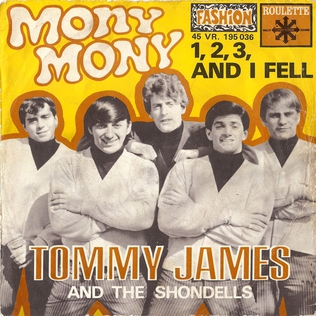
Way back in 1968, Tommy James and the Shondells were at the top of their game, writing, producing, and recording hit song after hit song. Songs like “I Think We’re Alone Now”, “Hanky Panky”, and “Crimson And Clover”. Each of these songs reached the top 4 on the Billboard Top 100 charts, and remained on the charts for weeks on end. But there is another song written by Tommy James which I believe became the best cover song of all time.

Tommy James wrote the music for this song before he had a title. He wanted a catchy name like many of the other hits of the day, but he just couldn’t come up with anything until one evening in New York when he and co-writer Richie Cordell were writing songs. They had just about giving up on finding the perfect name for the song when he walked out on the balcony of the hotel they were staying in and saw a bright red illuminated sign across the way that read “Mutual of New York”. And he knew immediately that he was going to name the song “Mony Mony” after that sign; “M. O. N. Y.” (True story)

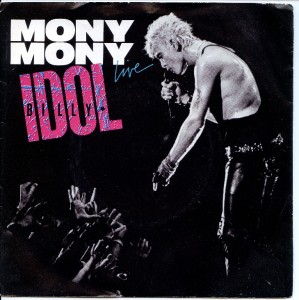
The Tommy James version of “Mony Mony” debuted in April of 1968 and reached #3 on the Billboard charts two months later in June. Fast forward thirteen years to 1981 when Billy Idol was looking for a song to complete an album and he suggested to his producers a cover of The Isley Brothers 1959 song “Shout”. But, he had a special affection for the song “Mony Mony”, and in the end “Shout” was rejected. Idol’s studio version of “Mony Mony” peaked at #7 on the Billboard Top 100 charts that year, and six years later in 1987, he released a live version that went to #1 on the charts. Ironically, when Idol’s live version reached #1 it replaced another Tommy James song; Tiffany’s cover version of “I Think We’re Alone Now”. Go figure.

And on a side note, about fifteen years ago I worked with a man who went to high school with Tommy James. That coworker’s name was Buz, and that is about as close as I have ever been to knowing someone famous.

So now you know what my opinion of the best cover of all time is: Billy Idol’s version of “Mony Mony”. Your opinion may differ though, and if it does I want to know what it is. Leave a comment below and come back and see me real soon right hear at As The Story Goes.

Tommy James – Mony Mony https://www.youtube.com/watch?v=pkMgs3lFwkQ

Billy Idol – Mony Mony https://www.youtube.com/watch?v=sYYAv-QW38Q

Did you know that you can have my blogs delivered straight to your inbox? Just visit my home page and sign up. https://as-the-story-goes.com/home/
The White Wing Dove

By Brad Gallagher:

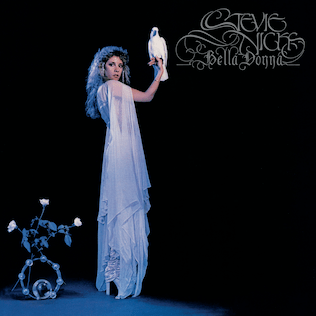
White wing doves are small birds that live in Arizona, who build their nests in the saguaro cactus to keep them protected from predator’s. When they sing, they sing a song that sounds like, Ooh.. Ooh.. Ooh… This is the bird that was the inspiration for Stevie Nicks’ 1981 hit song titled “Edge Of Seventeen”. This song premiered on her debut album titled “Bella Donna”.

Back in 1982, when I moved across the country , I took with me about 20 vinyl albums, and about 30 cassette tapes. “Bella Donna” was one of those tapes, and I listened to it over and over on that 3000 mile drive from Pennsylvania to Oregon. It has always been one of my favorite albums, and “Edge Of Seventeen” has always been one of my favorite songs.

But what does being on the edge of seventeen have to do with birds, anyway?

As The Story Goes:

In December 1980, Stevie Nicks was in Australia when she heard the news that John Lennon had been shot and killed. She had never met Lennon, but had heard a lot about him from a close mutual friend, and upon hearing the news she was deeply saddened. Her travel plans took her from Australia to Phoenix and she intended to write a song when she got there to honor Lennon, but upon her arrival in Phoenix she found out that her Uncle had just been diagnosed with cancer and so she spent her time at the hospital with him instead. Sadly her Uncle passed away a couple weeks later, and she ended up writing the song in honor of him as well as John Lennon.

On the flight out of Phoenix back to her home in California after her Uncle’s funeral, a flight attendant handed her a menu. On the menu, in addition to the food and drink offerings, it apparently had some stories about Phoenix and Arizona. One of these stories was about the white wing dove. It read,  ‘The white wing dove sings a song that sounds like she’s singing ooh, ooh, ooh. She makes her home here in the great Saguaro cactus that provides shelter and protection for her…”. 1 And that menu was her inspiration for the song.

The dove, a symbol of peace, was for Lennon who sang about peace. In her description of him she sings, “With the words from a poet and a voice from a choir. And a melody, and nothing else mattered”.

The dove also represents, to her, the spirit leaving the body at death, and she wrote part of the song it in memory of her last days in the hospital with her Uncle. She describes those days this way; “Well, I went searchin’ for an answer, Up the stairs and down the hall, And not to find an answer, Just to hear the call, Of a nightbird singing, “Come away”, “Come away”, Come away”.

Yes, I know what you are thinking. “So what does this have to do with the Edge of Seventeen?” Well, that is a different story.

As That Story Goes:

Some months or years earlier, Nicks was chatting with Jane Petty, Tom Petty’s first wife, and the subject came up of how the couple had first met. During the conversation, Jane said they met “at the age of seventeen”, but Jane’s strong Southern accent made it sound to Nicks like “At the edge of seventeen”. She liked the sound of the phrase so much that she told Jane she would write a song for it and give her credit for the inspiration. 2 Although Nicks had originally intended for the song to be about Tom and Jane Petty, she used the title for her song tribute to John Lennon and her Uncle. Sometimes it is interesting how artist’s minds work isn’t it.

The song “Edge of Seventeen” went on to reach #11 on the Billboard top 100 chart. Nicks’ debut solo album “Bella Donna” was released in July of 1981 and sold so well, it was awarded platinum status in less that three months after it’s release. A total of four songs from the album reached the top 40 on the Billboard charts, including the duet “Stop Dragging My Heart Around” with Tom Petty, and the duet “Leather And Lace” with Don Henley. The album itself reached number 1 on the Billboard 200 album chart, and spent almost three years on that chart.

So now you know a little trivia about Arizona’s white wing dove. Go tell a friend. And come back and see me real soon right here at As The Story Goes.

Edge Of Seventeen official video: https://www.youtube.com/watch?v=UmPgMc3R8zg

Did you know that you can have my blogs delivered straight to your inbox? Just visit my home page and sign up. https://as-the-story-goes.com/home/
 [1] Spanos, Brittany (April 7, 2020). “Stevie Nicks Meets Dove, Reveals ‘Edge of Seventeen’ Lyric Inspiration”Rolling Stone. Retrieved December 3, 2020

 [2] “Old Trivia Questions”. Retrieved September 11, 2007. She was telling me about Tom, about when she met him, and she has an incredible Southern accent … and she said that she met him at the age of seventeen, but I thought she said ‘edge,’ and she said ‘no … age’ and I said, ‘Jane, forget it, it’s got to be “edge.” The “Edge of Seventeen” is perfect. I’m gonna write a song, ok? And I’m gonna give you credit.’ She didn’t believe me, you know? She couldn’t believe it when it came out on the album.

A Controversy of The Heart

By Brad Gallagher:

You know those songs that stick in your head for days on end? Maybe a song with an intriguing riff or a mesmerizing back beat that keeps running through your mind? Maybe for you it is a specific lyric, or a repeating chorus. Well, whatever it is you just sit there and wonder to yourself, “How did I get this song in my head? I don’t even remember hearing it recently.”

Today I want to tell you about a song that I am almost positive you have heard before. And maybe you have heard it so many times during your life that at one point or another you found that it was running through your head. Over and Over. It is possible that the last time you heard it was in 2007 when your kids convinced you to buy them the “Guitar Hero III” game and you totally showed them up on the drums or the lead guitar while playing this song. It’s that song that starts off with that guitar riff that goes, “dun didi dun didi dun didi dun didi dun didi dun didi dun didi dun du… dinngggg!” That’s right, you know it, “Barracuda” by Heart.

As The Story Goes:

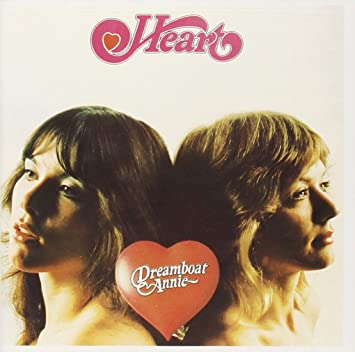
Up until 1977, the rock group Heart, featuring sisters Ann Wilson (Lead Singer) and Nancy Wilson (Guitarist), was under contract with a record label called Mushroom Records. Under this label they released their very successful debut album, “Dreamboat Annie” in 1975, and the controversial album, “Magazine” in 1977. “Magazine” was controversial due to the fact that at the time of it’s release, Heart was no longer under contract with them. Heart had been working on this album, but broke the contract with Mushroom before it was completed. Mushroom still released it without Heart’s permission after the contract had been broken even though it was only a partial album.

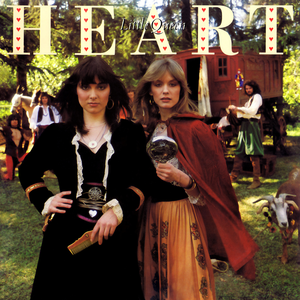
But why did Heart break their contract with Mushroom to begin with? You see, at one point during the period of time that Heart was recording “Magazine”, the promoters at Mushroom Records decided to launch a publicity stunt. Making reference to the picture on the cover of the album “Dreamboat Annie”, with Ann and Nancy Wilson standing back to back, bare shouldered, they released a rumor that the sisters were secretly lovers. Ann found out about the rumor one night after a concert when a radio promoter approached her and asked her about her lover. At first she thought he was talking about her boyfriend, but after a little discussion he told her that he was referring to her sister, and he told her all about the rumor. She got so mad that she went straight back to her hotel room and wrote the words to the song “Barracuda”, which appeared on their third album, “Little Queen”.

Growing up I always thought that “Barracuda” was a song that had something to do with a fish. Silly Me. In an interview, Hearts producer Mike Flicker, described it like this, “‘Barracuda’ was created conceptually out of a lot of this record business bullshit. Barracuda could be anyone from the local promotion man to the president of a record company. That is the barracuda. It was born out of that whole experience.”1

But that publicity stunt was not the only controversy surrounding this great song. Back in the early 70’s, prior to the song “Barracuda”, Heart had the opportunity, as a not so well known band, to go on a European tour and open for both Nazareth and Queen. At the time, Nazareth had a big hit with the remake of a Joni Mitchel song called “This Flight Tonight”. A song that featured the guitar riff; “dun didi dun didi dun didi dun didi dun didi dun didi dun didi dun…” Later, in 1977, when writing “Barracuda”, Heart used this same riff. And Nazareth was not happy.

Nancy Wilson said in a 2019 interview, “So we kind of borrowed that. And we made it into ‘Barracuda.’ And we saw the guys from Nazareth later and they were pissed. ‘You took our riff!’. But that’s kind of what everybody – you borrow from what you love and then you make it your own. It’s one of those sounds too, it’s one of those guitar tones that I’m still trying to figure out what we did. [Laughs] It’s hard to re-create.2

Still, “Barracuda” peaked at #11 on the Billboard Hot 100 chart in 1977. And the album, “Little Queen” topped out at #7 on the Billboard 200 album chart.

So now you know a little about the story behind “Barracuda”. Now you can not only beat your kids at “Guitar Hero III”, but you can bore them with trivia at the same time. So come back and see me real soon right here at As The Story Goes. And check out the videos below and you be the judge. Who’s use of this famous guitar riff is better?

Nazareth “This Flight Tonight”: https://www.youtube.com/watch?v=G9KxAYoHUAM

Heart “Barracuda”: https://www.youtube.com/watch?v=sfX-BSO-Q8M

Did you know that you can have my blogs delivered straight to your inbox? Just visit my home page and sign up. https://as-the-story-goes.com/home/
[1]  “Classic Tracks: Heart’s “Barracuda””. Mixonline. January 9, 1999. Retrieved October 12, 2016.

[2] “Heart’s Nancy Wilson: We Took ‘Barracuda’ Riff From Legendary Band”YouTube. March 5, 2019. Archived from the original on December 22, 2021.

The International Battle Of The Century

By Brad Gallagher:

Over the coarse of time there have been many famous battles. Such as, The Battle of The Bulge, The Battle of Bunker Hill, and The Battle at Little Big Horn to name just a few. In sports there was the famous “Thrilla in Manilla” between boxers Muhammad Ali and Jo Frazier, the 1980 “Miracle On Ice” hockey game between the US and the USSR, and of course the 1973 “Battle Of The Sexes” tennis match between Billy Jean King and Bobby Riggs.

The world of Rock has also had it’s share of famous battles. Like the battle between Led Zeppelin’s “Stairway To Heaven” and AC/DC’s “Highway To Hell”, or the fun loving battle between Neil Young and Lynyrd Skynyrd that was etched into rock history in their songs “Southern Man” and “Sweet Home Alabama” (more about that in a future post). But there was one rock and roll battle that is not quite as well known, and yet it involved two of the most famous groups in rock and roll history.

As The Story Goes:

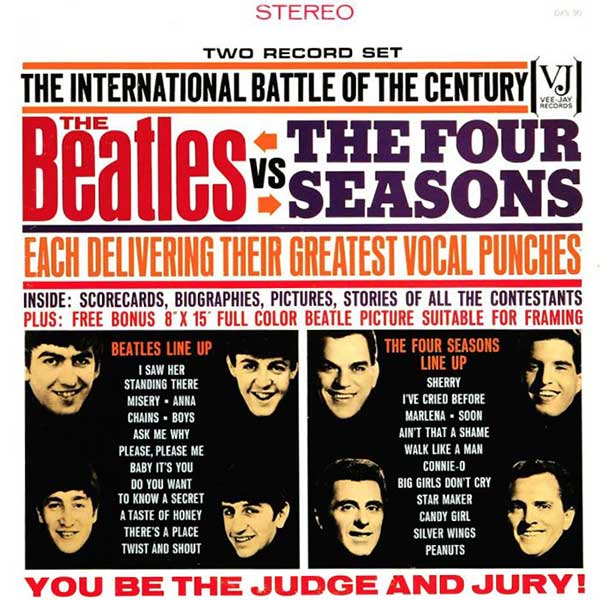
Back in 1953 Vivian Carter and her husband James C. Bracken started one of the very first African American owned record companies and with the help of some connections they had in the music industry they quickly became a very prominent label on the R&B music scene. But they did not want to limit themselves to signing only R&B artists, so in 1962 they entered into a deal with The Four Seasons after hearing their new song, “Sherry”. The Four Seasons was the first non-R&B group to sign with Vee-Jay records, and was also the first non-black group to be recorded under their label. However, in January of 1964 they decided to leave Vee-Jay due to Vee-Jay records’ reported financial troubles.

In 1963, after very much success in the UK, the Beatles decided to record in the US. They had been releasing their music under the EMI label in the UK, but EMI’s subsidiary in the US, “Capitol Records”, did not want to pick them up due to the fact that fans in the US didn’t even know who they were at that point in time. So, The Beatles looked elsewhere and were able to work a deal with Vee-Jay records. Unfortunately for Vee-Jay, The Beatles did not have great success under their label. In fact, The Beatles song “From Me To You” was their highest ranking song under the Vee-Jay label, only reaching number 116 on the Billboard charts. So, by the end of 1963 the Beatles decided to move on to the Swan label.

There was, however, one shining light for Vee-Jay records as a result of loosing both The Four Seasons’ and The Beatles’ recording contracts, and that was the fact that they retained the rights to their music. The two bands took Vee-Jay records to court, of course, over these rights and when the dust settled Vee-Jay lost. However, they were able to retained the rights to The Four Seasons songs that they had the masters of, and they were permitted to use 16 Beatles songs in any way they wanted to until October 15, 1964.

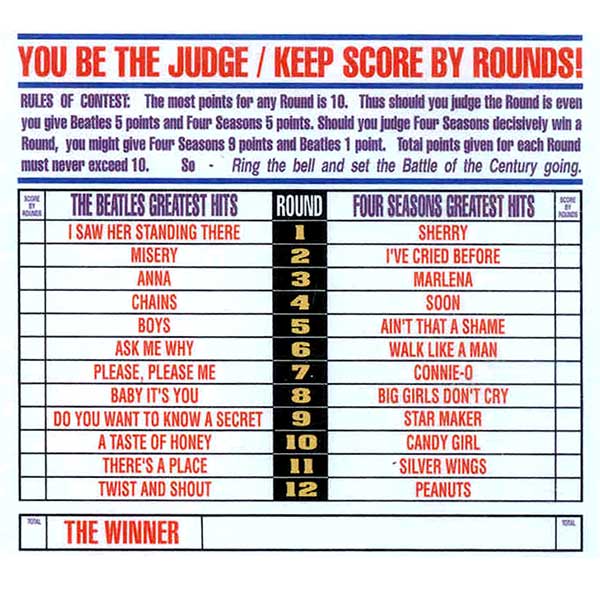
It was during those few months in 1964 that a battle ensued between these two iconic classic rock and roll bands, and not a single member of either band fought in any part of the battle. You see, Vee-Jay records, in an effort to milk as much profit out of their song rights as possible before loosing them, they released a double album set featuring songs that they had previously recorded by each of these two groups . This album was titled “The Beatles vs The Four Seasons”. The album featured 12 songs by each of the bands and was set up to be a contest between the two groups with the listener being the judge. On the front cover, the album was billed as “The International Battle Of The Century”, (The Four Seasons being from New Jersey, and The Beatles from Great Brittan). The back cover was set up as a score card, complete with the rules, and all of the songs listed in order as to which Beatles song would competing against which Four Seasons song in each of the 12 rounds. Boxes were added to the score card to give points for each round, and boxes at the bottom for point totals. The listener was supposed to listen to each of the songs in the round and score them against each other. After the 12 rounds were complete the winner would be determined by the total points given to each group.

It was a brilliant marketing idea, but unfortunately for the fans of both groups they released fewer than 20,000 copies of the album. They feared that the since the double album would cost so much more than most people were accustomed to paying for a single album, it wouldn’t sell very well. But now, nearly 60 years later, these albums are much sought after, with original copies being offered anywhere from $250.00 to over $4000.00 depending on condition. I even saw a less than perfect copy being offered at over $10,000.00 OBO. Go figure.

On a side note, though, if anyone is still looking for a Christmas gift Idea for me, I do not as yet have a copy of this one. Original only please….. HaHa! Come back and see me real soon right here on As The Story Goes.

Did you know that you can have my blogs delivered straight to your inbox? Just visit my home page and sign up. https://as-the-story-goes.com/home/
Larry Rivera

By Brad Gallagher:

My wife, Shari, and I spent the last couple weeks in Hawaii on the beautiful garden island known as Kauai. So, I thought it would be appropriate to write a story with something about Hawaii in it. On our second day on Kauai, we drove past a hotel which was once known as the Coco Palms Resort, and my thoughts went back a few years to the evening when we had the privilege of meeting Larry Rivera.

I know what you are thinking… Who in the world is Larry Rivera? Admittedly, he is not a rock star. Again, I know what you are thinking… These stories are supposed to be about classic rock and roll, right? Well, yes they are. So bear with me and keep reading while I introduce you to a singer/song writer who has direct connections to rock and roll.

As The Story Goes:

In 1951, a young man named Larry Rivera took a job at a small businessmen’s lodge on the east shore of Kauai as a waiter. Later that year he was drafted into the US army and was stationed at a base on Oahu. At one point during his two years on Oahu a talent show was organized which included singers from 35 different army installations throughout Hawaii. Larry decided to assemble a small group, just him and two other guys, and enter the contest. They called themselves “The Beach Boys”. (And that was ten years before the formation of that other group with the same name). These Beach Boys finished first place in that talent show, and it was there and then that Larry found what he referred to as his true calling; Music.

After his time in the army, Larry returned to his job at the lodge, but the lodge had been sold and renamed “The Coco Palms”. With his newfound love for music, he was able to work his way into the entertainment scene at the Coco Palms resort, and became a regular act in the hotel lounge. He wrote and performed much of his own music and was eventually picked up by a local radio station and his singing career took off from there.

I know… So what does this have to do with rock and roll? Other than the Beach Boys reference? Well, in 1953 Hollywood discovered the Coco Palms resort and began filming movies there such as “Miss Sadie Thompson” starring Rita Hayworth and Jose Ferrer. And later in 1961, “Blue Hawaii” staring “The King of Rock and Roll”, Elvis Presley. It was in this movie that Elvis recorded one of his most famous songs, and the song that he ended each concert with, “Can’t Help Falling In Love”. During Elvis’s filming of Blue Hawaii, he met Larry Rivera and the two became fast friends. Larry still talks about watching Elvis film Blue Hawaii and points out, to those who will listen, the different locations around the property where the famous scenes were filmed, such as the wedding of Chad and Maile.

As the years went by, every time Elvis visited the Coco Palms he made it a point to catch Larry’s show in the lounge. Elvis would sit in the audience at a table with Larry’s wife, Gloria, and from time to time, the King of Rock would even go up on stage and sing background vocals for Larry.

Larry also befriended other famous singers while working at the Coco Palms such as Bing Crosby, Frank Sinatra, Patti Page, and Don Ho. Unfortunately though, in 1992 the Coco Palms resort was devastated by hurricane Iniki and to this day has not been restored. Next to his wife Gloria, the Coco Palms resort was the love of Larry’s life. Even after the resort closed it’s doors and stopped housing guests, Larry used the grounds to host weddings for many years. They were called “Blue Hawaii” weddings, patterned after Chad and Maile’s wedding at the end of the movie.

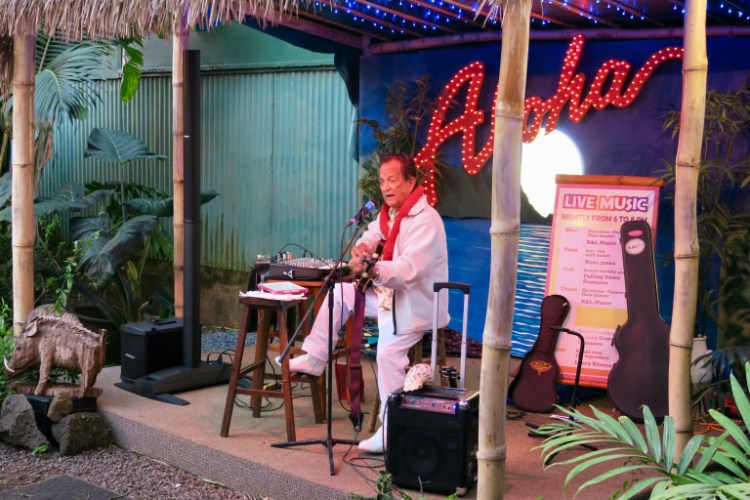
And as I mentioned at the beginning of this post, Shari and I met Larry a few years ago when he was performing at a restaurant called “The Island Garden Grill”. He was 89 years old at the time. And before he started his show that night he walked around the restaurant from table to table and gave each if the ladies in the audience a plumeria flower to put in their hair. We often chuckle when we recall that evening because at 89 he was getting a little hard of hearing, and when he came to our table Shari said, “How are you?” And Larry responded with, “No, have I met you?” He then took the stage and told us every story he remembered about his time at the Coco Palms and the beautiful island of Kauai. And he sang all of his favorite songs.

Larry Rivera was never a rock star but he befriended and sang with rock stars as he entertained audiences for years in his own unique Hawaiian style. He absolutely loved Kauai and the Coco Palms resort, and as far as I know he is still alive and well , living his best life, now in his nineties, on the beautiful island of Kauai.

So now you have been introduced to one of Hawaii’s most famous singers and good friend of the King of Rock.

Larry Rivera performing at the Garden Island Grill:

Elvis in Blue Hawaii: https://www.youtube.com/watch?v=-t6VqfqQLQI

Come back and see me real soon right here at As The Story Goes.

Did you know that you can have my blogs delivered straight to your inbox? Just visit my home page and sign up. https://as-the-story-goes.com/home/
Bennie Who?

By Brad Gallagher:

During his career Elton John has had 57 songs reach the top 40 on the US Billboard Hot 100 charts, second only to Elvis Presley. 27 of those songs reached the top 10. And if that wasn’t enough, nine of those songs peaked at #1.

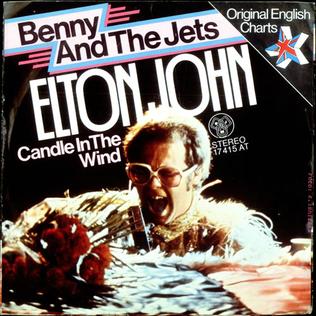
Those nine songs were, “Crocodile Rock” on February 3, 1973; “Lucy In The Sky With Diamonds” on January 4, 1975; “Philadelphia Freedom” (one of my personal favorites) on April 12, 1975; “Don’t Go Breaking My Heart” (with Kiki Dee) on August 7, 1976; “Island Girl” on November 1, 1975; “That’s What Friends Are For” (Donnie & Friends) on January 18, 1986; “Don’t Let The Sun Go Down On Me” (with George Michael) on February 1, 1992; “Candle In The Wind 1997” on October 11, 1997; and of course, “Bennie And The Jets” on April 13, 1974.

But, who is Bennie? It is difficult to tell just by listening to the song. In fact, most of the words of the song are next to unintelligible while being sung. Sure, you can make out some of the words, like “B-B-B-Bennie and the Jets”, and “Have you seen them yet?”, and of course “You know I read it in a magazine.” So, what is this song really all about?

As The Story Goes:

Back in the early 1970’s the music industry was going through an odd transformation. It was very popular among rock artists at the time, like David Bowie, Gary Glitter, and of course Elton John to dress up in outlandish costumes and portray themselves as glamorous, eccentric, affluent people. They called it Glam Rock. And during that same time period, a number of books were being published that were exploring science fiction and futuristic societies. And, as it is today, the movie industry was portraying those books on the silver screen. Science fiction was captivating the masses. And Elton John’s friend and song writer, Bernie Taupin, was not to be left behind. Even though all of the music for Bennie And The Jets was written buy Elton John, the words were written by Taupin.

Taupin wanted to create a story which fit with the current sci-fi craze, while at the same time satirizing the 1970’s music industry. In this song, Bennie is a female character who Elton has referred to as a “Sci-fi rock goddess”. The song is about this futuristic rock star and her futuristic all female android band known as “The Jets”, who Taupin says remind him of the robotic models in Robert Palmer’s music video “Addicted To Love”. It is sung from the point of view of a narrator who is a super fan of Bennie.

So, as for the words: The first verse goes like this,

“Hey, kids, shake it loose together
The spotlight’s hitting something
That’s been known to change the weather
We’ll kill the fatted calf tonight
So stick around
You’re gonna hear electric music
Solid walls of sound”

The narrator urges his fellow fans to come out and hear the band play. He tells them how great the band is and how much they will regret not being there. The reference to the fatted calf is a depiction of the wealth and status of the rock stars of the 70’s.

The chorus goes as follows:

“Say, Candy and Ronnie. Have you seen them yet?
Ooh, but they’re so spaced out
B-B-B-Bennie and the Jets
Oh, but they’re weird and they’re wonderful
Oh, Bennie. She’s really keen
She’s got electric boots, a mohair suit
You know I read it in a magazine, oh
B-B-B-Bennie and the Jets”

In this chorus he describes the flashy wardrobe worn by Bennie onstage. Many people over the years have thought he was saying, “She’s got electric boobs”, but no, he says “electric boots, a mohair suit” referring to her outfit. The reference to mohair, which is an expensive wool that takes dies very well, facilitates the flamboyant costume she wore on stage. And Candy and Ronnie are said to be fictitious characters who represent the teeny boppers of the day. It is all wrapped up in the tabloid where he says he “read it in a magazine”. Originally the song was written as just “Bennie and The Jets”, but Elton added the “B-B-B-” in the studio and it stuck.

He goes on in the second verse to describe the ongoing struggle of the youth of that generation who almost worshipped these rock stars while their parents tried as best they could to keep their kids away from their influence. He talks about the conflict between the parents and the kids, and speculates that eventually they will find out who is right and who is wrong.

“Hey, kids, plug into the faithless
Maybe they’re blinded
But Bennie makes them ageless
We shall survive, let us take ourselves along
Where we fight our parents out in the streets
To find who’s right and who’s wrong”

And finally closing the song out with a repeat of chorus:

“Say, Candy and Ronnie, have you seen them yet?
Ooh, but they’re so spaced out
B-B-B-Bennie and the Jets
Oh, but they’re weird and they’re wonderful
Oh, Bennie. She’s really keen
She’s got electric boots, a mohair suit
You know I read it in a magazine
B-B-B-Bennie and the Jets”

The actual recording of Bennie and the Jet is an interesting story also. The opening chord that Elton plays was said to be totally by accident. He was off his timing a little in the recording studio and hit that chord a moment too soon. However, the producer, Gus Dudgeon turned to the sound engineer and said ” What does that remind you of?” The engineer said that it reminded him of what musicians do on stage to get the audience to quiet down right before they start their set. Just a note or two and the audience quiets down. So, Dudgeon thought, “maybe we should fake a live performance”. And they did. They dubbed in some crowd noise from a show Elton did in 1972 at the Rose Festival Hall in London and made it sound like a live recording even though it is a studio recording. And that is the studio recording that we hear on the Goodbye Yellow Brick Road album.

Another interesting tidbit is the falsetto voice that is heard in the middle of the refrain. Apparently, Elton John was a big fan of Frankie Valli when he was a kid, and decided to add the high pitched voice into the chorus in honor of Valli, and that is why we hear the falsetto, “Bennie…Bennie…Bennie… Bennie and the Jets” in the chorus.

So click on the link below and enjoy one of rock and roll’s greatest songs. Bennie and The Jets.

And join me right here next time on As The Story Goes.

Click this link to watch Bennie & The Jets live in concert video: https://www.youtube.com/watch?v=4hX5fRbsmE8

Did you know that you can have my blogs delivered straight to your inbox? Just visit my home page and sign up. https://as-the-story-goes.com/home/